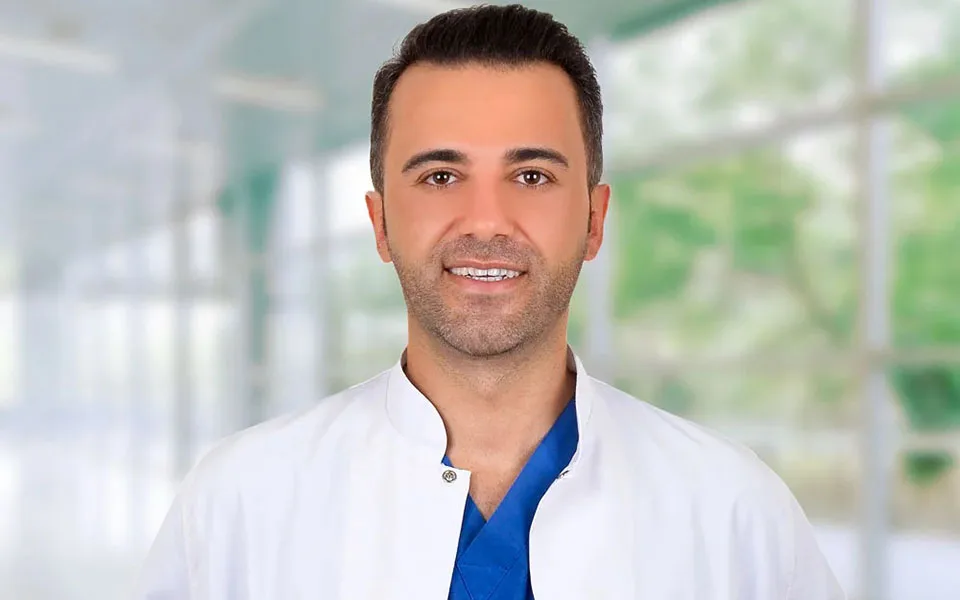
Surgeon profile
Op. Dr. Ümit Küçüktepe
ENT & Head and Neck Surgery Specialist
Careful evaluation comes before technique. Planning considers nasal anatomy, facial harmony, breathing where clinically relevant, and the goals discussed with each patient.
- Specialty
- ENT & Head and Neck Surgery
- Medical degree
- 2014 · Cerrahpaşa
- Research
- 3 selected publications
01 / Professional biography
A considered approach to the nose as part of the face.
Op. Dr. Ümit Küçüktepe is an ENT and Head and Neck Surgery specialist whose professional focus includes rhinoplasty, septoplasty and septorhinoplasty.
His approach begins with the individual rather than a standard nose shape. Facial proportions, skin characteristics, nasal anatomy, functional needs and personal expectations all inform the planning conversation.
Professional profile in context
ENT training, hospital experience and clinical research
According to his official biography, Ümit Küçüktepe graduated from Istanbul University’s Cerrahpaşa Faculty of Medicine in 2014 with a High Honor Certificate. He subsequently completed ENT and Head & Neck Surgery training at the University of Health Sciences Antalya Training and Research Hospital. A separate specialist announcement by the Turkish ENT society corroborates his specialist examination at the Antalya training centre. His biography describes an interest in rhinoplasty during residency and continued participation in scientific courses and meetings.
Şırnak State Hospital announced his appointment on 15 October 2019. A further institutional record dated 16 January 2020 described septorhinoplasty, septoplasty, total septal reconstruction, endoscopic sinus surgery and turbinate reduction, alongside ear, tonsil, adenoid and laryngeal procedures. These historical records place nasal surgery within a broader ENT background; they do not establish a present hospital appointment.
His public practice material discusses individual planning, open and closed access, revision rhinoplasty and piezo-assisted work. These terms answer different questions: access describes how the surgeon reaches structures, an instrument describes one tool, and the treatment objective describes what is being addressed. A consultation should connect all three to the patient’s anatomy and priorities rather than relying on a technique label.
What the research explores
The three selected publications below address nasal assessment, facial nerve disease and sleep-related breathing. Their questions and study designs are explained individually so that a reader can distinguish clinical research from a claim about cosmetic results. Study participants are not a count of operations performed by the doctor.
Source coverage: Official professional biography; Turkish ENT society specialist announcement; Şırnak State Hospital announcements, 15 October 2019 and 16 January 2020; official nasal-surgery information; journal records below.
02 / Medical background
Education and professional journey
Verified milestones from the doctor’s official biography and public institutional records.
- 2014
Medical degree
Graduated from Istanbul University Cerrahpaşa Faculty of Medicine with a High Honor Certificate.
- Specialist training
Otorhinolaryngology and Head & Neck Surgery
Completed specialist training at the University of Health Sciences Antalya Training and Research Hospital.
- 2019
ENT specialist appointment
Appointed as an ENT specialist at Şırnak State Hospital, where official hospital records document outpatient care and operations within the ENT specialty.
- Continuing development
Nasal health and aesthetics
Participates in professional courses, scientific meetings and congresses relating to nasal health and aesthetics, including as a participant and speaker where stated in the official biography.
03 / A focus on nasal surgery
Function, proportion and individual planning
Rhinoplasty is not planned from one photograph or one preferred technique. The assessment brings several connected considerations into one clinical plan.
Anatomy
The existing nasal framework, skin characteristics and facial proportions are assessed together.
Function
Breathing concerns are considered where clinically relevant; the website does not diagnose or promise a functional outcome.
Goals
Expectations are discussed directly so the plan can remain proportionate, realistic and personal.
04 / Surgical planning
Technique follows the assessment.
The official biography describes experience with open-technique piezo rhinoplasty and closed-technique rhinoplasty.
Open approach
An open approach may be selected when the anatomy and planned structural work make that access appropriate.
Closed approach
A closed approach may be considered in selected cases. “Closed” does not automatically mean simpler or better.
Piezo / ultrasonic assistance
Piezo instruments may assist with selected bony work. They do not replace the full operation or guarantee less swelling, bruising or a faster recovery.
No single technique is universally superior. The final approach is selected after an in-person examination and individualized planning.
05 / Revision rhinoplasty
A new assessment, not a repeat of the first plan.
Revision planning considers previous surgery, current anatomy, available tissue, function and present goals. The appropriate approach varies; correction, breathing improvement and aesthetic outcomes cannot be guaranteed.
06 / The consultation
What happens when you meet the surgeon?
The meeting is designed to turn questions, examination findings and expectations into a clearer clinical discussion.
- 01
Listen
Discuss your goals, concerns, previous treatment and the questions that matter to you.
- 02
Assess
Review nasal anatomy, facial proportions and functional or breathing considerations where relevant.
- 03
Plan
Discuss an individualized surgical direction, practical limits and the technique that may be appropriate.
- 04
Clarify
Use planning or simulation imagery as a communication aid and leave time for questions before a decision.
A simulation is a planning and communication tool. It is not a prediction or guarantee of the final surgical result.
Understanding nasal surgery
Different goals. One carefully considered plan.
A useful consultation separates what you would like to change from what an examination can establish. The guide below explains the vocabulary used in nasal surgery. It is general education, not a description of this doctor’s personal technique or a recommendation for your case.
Form
What would you like to change about your nose within the proportions of your face?
Breathing
Which symptoms need an internal examination and discussion of possible causes?
History
How do previous treatment, health and expectations inform the discussion?
Conceptual planning diagram, not a diagnostic image or a prediction of surgical results.
Rhinoplasty: the external shape
Rhinoplasty changes the shape or size of the nose. Open and closed describe access through different incision patterns; these words alone do not tell you what structural work is planned. Ask your surgeon to explain the proposed changes, their limitations and why that access suits your anatomy.
NHS · Nose reshaping (rhinoplasty)
Septoplasty: the internal partition
The septum divides the two nasal passages. A deviation can contribute to obstruction, but an off-centre septum does not always cause symptoms. Assessment considers other contributors, including the turbinates and nasal valves. Septoplasty addresses the septum; a combined septorhinoplasty also addresses the external nose.
AAO-HNSF / ENT Health · Deviated Septum
Revision: understand the earlier operation
If you have already had surgery, make that clear at the outset and bring any available operative records. A useful consultation should distinguish the concern you see today from the correction being proposed. Ask what can realistically change, what may remain and whether further surgery is appropriate at all.
ASPS · Rhinoplasty consultation; editorial consultation prompts
Arrive with a history, leave with clear questions.
Prepare your medical conditions, allergies, current medicines and supplements, smoking or alcohol history and previous procedures. Describe both appearance and breathing concerns. The consultation should include examination, available options and an explanation of risks. Do not change prescribed medicines yourself; ask the treating team for individual instructions.
ASPS · Rhinoplasty consultation
Recovery is a sequence, not a reveal.
This visual is an orientation to follow-up, not a fixed timetable. The treating surgeon determines your care and review schedule.
- 01
Initial care
Splints or dressings may protect the nose. Obtain written instructions on care, medicines and the next review.
- 02
Early review
Ask who removes dressings or sutures, when you can resume activities and whom to contact with concerns.
- 03
Ongoing healing
Swelling changes over time; refinement can take up to a year. An early photograph is not the final assessment.
- 04
Continued follow-up
Confirm how reviews continue after you return home and how persistent concerns will be assessed.
ASPS · Rhinoplasty recovery
Discuss the trade-offs before deciding.
Possible risks include breathing difficulty, infection, altered sensation, scarring, septal perforation, dissatisfaction with appearance and further surgery. Anaesthesia has its own risks. Ask which are relevant to your health and proposed operation, how complications would be managed and what alternatives are available.
ASPS · Rhinoplasty risks and safety
07 / Scientific work
Questions explored through clinical research
Selected, verifiable publications connected to ENT practice, nasal assessment, facial nerve presentations and sleep-related breathing.
- 01
Could imaging change a septoplasty plan?
2018 · Retrospective study · 378 patients
This co-authored study examined whether sinus CT findings in patients initially assessed for septoplasty identified additional conditions associated with procedures such as turbinate or sinus surgery. The clinical question was how a fuller assessment might affect planning.
This was not a cosmetic-rhinoplasty outcomes study and does not establish that every patient needs CT imaging.
Is Performing the Paranasal Sinus CT Before the Septal Operation Change the Indication of Surgery?
European Journal of Rhinology and Allergy, 2018; 1(2): 43–46
DOI: 10.5152/ejra.2018.59561
- 02
Does Bell’s palsy show a seasonal pattern?
2019 · Record review · 816 included cases
The researchers reviewed 1,143 records and included 816 that met the study criteria for Bell’s palsy. Küçüktepe co-authored the investigation into how presentations in Antalya were distributed across months and seasons.
This concerns facial nerve disease and epidemiology. The dataset is not a count of operations performed by the doctor.
Seasonal distribution of the incidence of Bell's palsy
Medicine Science, 2019; 8(3): 750–753
DOI: 10.5455/medscience.2019.08.9053
- 03
What can blood markers tell researchers about sleep apnoea?
2025 · Online 2022 · Comparative study · 88 patients
Küçüktepe is first author of this study comparing hepcidin and paraoxonase in sleep-tested patients across simple-snoring and obstructive sleep-apnoea groups. The researchers reported an association between paraoxonase and severity, without supportive results for hepcidin.
The findings do not replace a clinical sleep assessment or show that nasal surgery treats every cause of sleep apnoea.
Serum hepcidin and paraoxonase levels in patients with severe, moderate, and mild obstructive sleep apnea hypopnea syndrome (OSAS): A comparison between OSAS patients and simple snoring patients
CRANIO, 2025; 43(1): 33–39. Online: 6 May 2022. PMID: 35522038
PMID: 35522038
08 / Professional memberships
Professional community
Memberships listed in the doctor’s official biography.
- Turkish Society of Otorhinolaryngology and Head & Neck Surgery
- Western Mediterranean Society of Otorhinolaryngology and Head & Neck Surgery
09 / International patient care
A pathway designed for clear coordination.
International care involves more than the procedure itself. Assessment, written scope, travel coordination, consultation, clinical planning, recovery checks and communication after returning home form one connected pathway. Individual inclusions are defined in the confirmed plan.

11 / Patient questions
Clear answers before a decision
What is Dr. Ümit Küçüktepe’s specialty?
He is an Otorhinolaryngology (ENT) and Head & Neck Surgery specialist.
Where did he study medicine?
He graduated from Istanbul University Cerrahpaşa Faculty of Medicine in 2014 with a High Honor Certificate.
Where did he complete specialist training?
At the University of Health Sciences Antalya Training and Research Hospital.
Does he focus on rhinoplasty?
His stated professional focus includes rhinoplasty, septoplasty and septorhinoplasty.
Does he perform revision rhinoplasty?
Revision rhinoplasty is part of his stated nasal-surgery practice; suitability and planning require an individual assessment.
Does planning consider breathing as well as appearance?
Functional and breathing considerations are assessed where clinically relevant alongside facial harmony and aesthetic goals.
Does he use open and closed techniques?
His official biography describes open-technique piezo rhinoplasty and closed-technique rhinoplasty. The approach is selected for the individual case.
What is piezo rhinoplasty?
Piezo or ultrasonic instruments may assist with selected bony work during rhinoplasty. They do not perform every part of the operation or guarantee a recovery advantage.
Will I meet my surgeon before surgery?
Yes. The care pathway includes an in-person consultation and clinical evaluation before final surgical planning.
What is simulation used for?
It supports discussion of direction and expectations. It is not a promise or guaranteed preview of the result.
Does the private practice have international health-tourism authorization?
Yes. The verified certificate number is ST-3430.
Where can I see his scientific work?
Selected verified publications are presented in the scientific-work section above.