How to Fix a Crooked Nose: Rhinoplasty in Turkey
See how nasal bones and cartilage contribute to the shape of a crooked nose. This animation illustrates internal structures and a surgical correction, helping you prepare questions before a rhinoplasty consultation in Turkey.
A visible deviation and a deviated septum are different findings. Your appearance and breathing concerns need an individual assessment; an animation cannot establish which treatment you need or predict your result. Video: KAMINSKYI. Patient-information context: Rhinoplasty Team Turkey.
Watch on the dedicated video page
Questions to take to a consultation
- Which structures account for the visible deviation, and which contribute to breathing symptoms?
- Which part of the proposed treatment addresses each finding?
- What asymmetry or breathing symptoms might remain?
Crooked nose correction in Turkey starts with identifying what is off-centre: the visible bridge or tip, the septum inside the nose, or several structures together. Rhinoplasty changes the external framework; septoplasty addresses the septum; septorhinoplasty can combine both when the examination supports that plan.
The useful question is not simply whether a nose can look straighter. It is which changes are realistic while protecting nasal support and breathing. This guide helps you prepare that discussion and organise care in Turkey. It is general information, not a diagnosis or a treatment plan.
- Appearance
What looks off-centre?
Describe the bridge and tip from appropriate views.
- Breathing
What feels obstructed?
Describe the side, timing and situations that affect breathing.
- Plan
What does each proposed step address?
Connect examination findings, goals, alternatives and follow-up.
A conversation map, not a diagnosis or a surgical simulation.
A crooked nose and a deviated septum are different
An external deviation describes the visible alignment of the nose. A deviated septum concerns the partition of bone and cartilage between the nasal passages. They can occur together, but a profile photograph cannot establish either the full front-view alignment or the source of obstruction.
Describe appearance and breathing separately. For example: “The bridge appears to lean left in frontal photographs” and “The right side feels blocked when I exercise.” These observations are useful starting points without deciding which operation you need. The functional rhinoplasty guide explains why breathing deserves its own assessment.
Why the nose may be off-centre
A history of injury can matter, including an old sports injury that was never assessed. Differences can also develop as the nose grows, without a remembered accident. Previous nasal surgery adds another history to consider. Avoid assuming that one visible feature proves trauma or a surgical error.
Prepare a short chronology: when you first noticed the shape, whether it changed suddenly, any injuries or operations, and when breathing symptoms began. Bring earlier photographs or operative records if available. Say when a detail is uncertain; a guessed explanation can be less useful than an honest gap.
A recent injury with significant pain, new obstruction or bleeding needs prompt local medical assessment. It should not be treated as an elective travel-planning question.
What a consultation should assess
A useful consultation connects your goals with examination of the outside and inside of the nose. Explain prior treatment, medical conditions, allergies and medicines or supplements. Do not stop prescribed treatment because of an online article; ask the responsible clinician for individual instructions.
Ask which findings relate to the bridge, tip, septum or nasal valves. Enlarged turbinates or inflammation may also contribute to blockage. The clinician decides whether further examination or testing would change the plan. Do not assume that every person needs a scan.
Photographs help communicate a concern, but do not reliably diagnose internal nasal valve collapse. The AAO-HNS distinguishes valve treatment from septoplasty: one does not automatically replace the other. A straighter-looking bridge is therefore not proof of a fully assessed airway.
Which treatment options may be discussed?
Septoplasty and septorhinoplasty
Septoplasty targets the septum. It is not a general promise to straighten the visible bridge. When septal and external structural concerns overlap, septorhinoplasty may be considered. Ask the surgeon to explain which part of the proposed operation addresses each concern.
An appearance concern alone does not establish the need for functional surgery. Likewise, a breathing complaint does not mean every external change is required. Ask what the alternatives are, including no operation or treatment of a different cause of obstruction where appropriate.
Osteotomies and cartilage support
If the bony framework needs repositioning, controlled bone cuts, called osteotomies, may form part of the operation. Cartilage work or grafts may be used to reshape or support selected areas. These are possible tools, not a standard package for every crooked nose.
If a graft is proposed, ask what it supports, where the cartilage would come from and what additional risks that creates. The septum, ear or rib may be discussed depending on the case. Previous operations and the available tissue can affect the options; a photograph cannot settle that choice.
Open or closed access
Open and closed describe routes of surgical access. Neither label alone determines whether a particular deviation can be corrected safely. Use the open versus closed rhinoplasty guide to prepare questions about the work proposed, access, scars and follow-up.
Ask “Why does this approach suit the structures you found?” rather than choosing solely from an advertised technique. The answer should remain specific to your examination and priorities.
What improvement can realistically mean
Define the goal with the surgeon: a less obvious lean, better balance in frontal views, a change in the tip, breathing improvement, or a combination. Discuss what may remain asymmetric. Absolute symmetry and a guaranteed result are not reasonable promises.
Agree how appearance and function will be reviewed separately. A photograph can document contour; it does not measure all aspects of breathing. Early postoperative images also show a stage of healing, not necessarily a settled result.
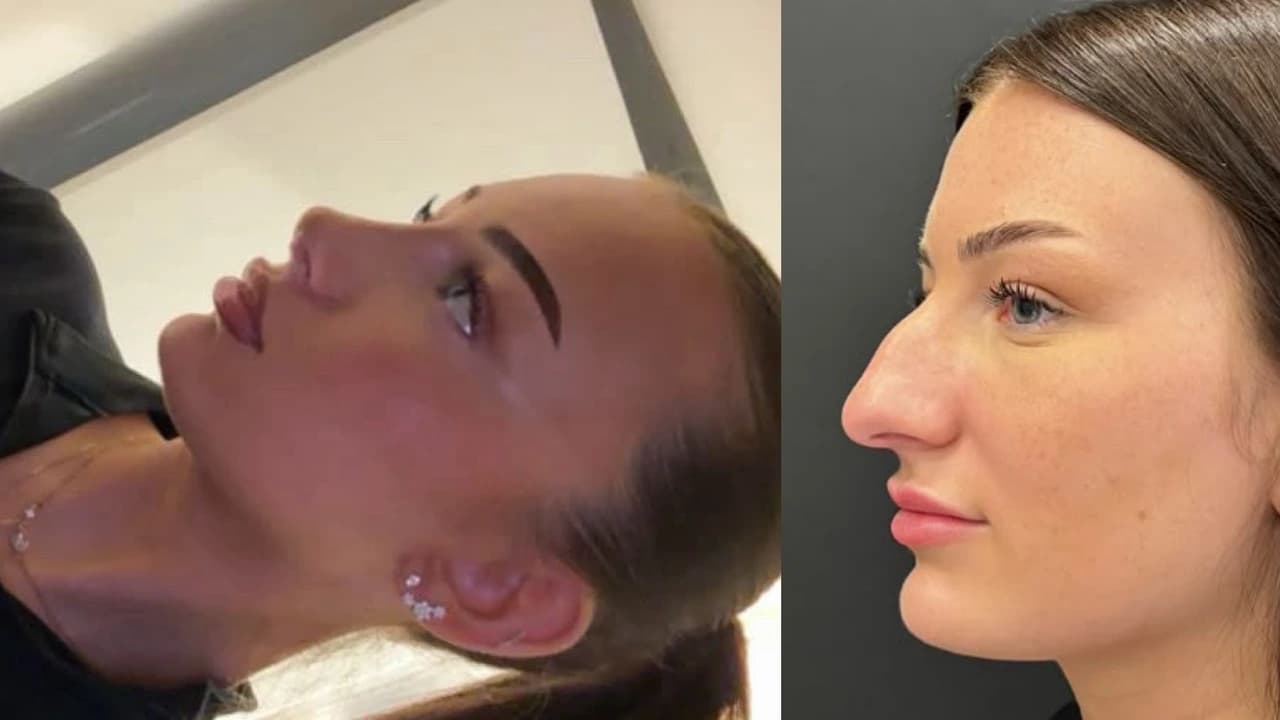
The photograph accompanying this article contains two profile views with different lighting and surroundings. No treatment, chronology or provider is established by the image. It cannot demonstrate front-view correction or predict another person’s outcome.
Risks to discuss before deciding
Potential problems include bleeding, infection, altered sensation, scarring, breathing difficulty, septal perforation and an appearance that does not meet expectations. Further surgery may be considered in some circumstances. Discuss the risks of your proposed operation rather than relying on an unexplained success percentage.
Ask what residual or recurrent deviation would mean in your case, when it could be assessed and how a later concern would be handled. Written follow-up arrangements should explain responsibilities and possible additional costs without suggesting that revision is inevitable or free.
Recovery: distinguish comfort, activity and contour
Early congestion, swelling and bruising can occur after nasal surgery. Follow your own discharge plan for dressings, splints, wound care and review. Ask when to seek advice about symptoms and who is available outside normal hours.
Return to work, exercise and travel are separate decisions. ASPS notes that contour refinement can continue for up to a year; that general description is not a personal deadline. The recovery guide provides broader context.
Increasing pain, fever, concerning discharge or persistent bleeding warrants prompt contact with the treating team. Severe breathing difficulty or another emergency requires local emergency help. Do not wait for a reply from an overseas clinic when urgent assessment is needed.
Planning treatment and follow-up in Turkey
Before booking, request a written plan covering the clinical assessment, proposed procedure, operating location, early reviews and contact arrangements after returning home. Ask who is responsible for each stage and how you can obtain your records.
For travel from the UK, Germany or France, separate the planned return date from medical clearance to fly. Leave room to change arrangements if the team advises an additional review. Confirm your insurer’s actual terms for planned treatment and complications; do not assume ordinary travel cover applies.
Compare the scope of care rather than a headline package. Use the Rhinoplasty Team Turkey cost guide for the existing indicative information and request an individual written quotation. A complex functional or revision plan should not be priced by copying a primary rhinoplasty example.
Questions to take to your consultation
- Which visible structures are off-centre, and what is the evidence for a separate breathing problem?
- What would septoplasty address, and what would external framework work add?
- Would osteotomies or a graft be needed, and why?
- Which asymmetries may remain despite an appropriate operation?
- How will breathing and appearance each be followed?
- What reviews are required before departure and after I return home?
- Whom should I contact about an urgent concern, and what costs are outside the quotation?
Write your priorities in order before the appointment. A focused discussion of two or three concerns is more useful than trying to reproduce someone else’s photograph.
Frequently asked questions
Will septoplasty straighten my whole nose?
Not necessarily. Its target is the septum. Visible deviation requires assessment of the external framework as well; combined surgery may or may not be appropriate.
Can a side-profile photograph show whether my nose is crooked?
It can show a profile concern but cannot establish the complete alignment or diagnose breathing problems. Clinical assessment and appropriate views are needed.
Is one surgical technique best for every crooked nose?
No single access label or instrument determines the plan. Ask how the proposed technique addresses the findings and what its limitations are.
How long should I stay in Turkey?
Agree the review schedule and travel clearance with the treating team before making fixed commitments. A standard package duration is not individual medical clearance.
Does correction guarantee perfect symmetry?
No. Discuss achievable changes, remaining asymmetry and uncertainty before consent. Neither an edited simulation nor a photograph guarantees the result.
Sources and editorial context
Source information checked on 14 October 2026: ENT Health; AAO-HNS clinical indicators and nasal valve position statement; ASPS rhinoplasty guidance; NHS rhinoplasty information; Cambridge University Hospitals septorhinoplasty aftercare. This is an editorial guide, not a claim of individual clinical review.
Rhinoplasty Team Turkey
Continue your research
Rhinoplasty Team Turkey