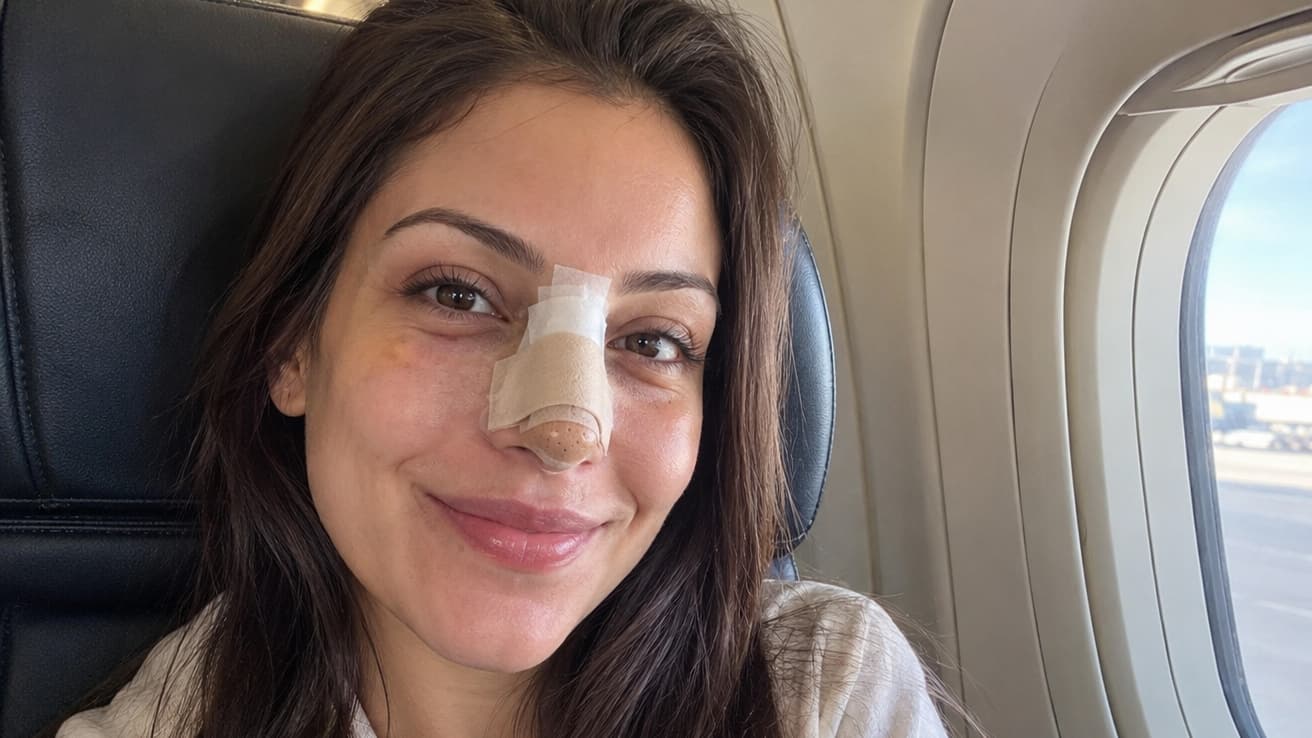
There is no single waiting period that makes flying safe for everyone after rhinoplasty. Your operating surgeon should assess recovery and the journey you actually plan, and you must meet the airline’s requirements. A return ticket, a comfortable day or removal of a splint does not provide that assessment. Keep your proposed departure flexible until the required review has taken place.
This guide focuses on the decision to fly and the journey home. The stay-planning guide explains how consultation, hospital observation and early appointments fit into your time in Turkey. Neither guide can clear an individual passenger for travel.
How long should you wait?
Published advice gives context, not a countdown to automatic clearance. The NHS’s general guidance on cosmetic surgery abroad recommends avoiding flights for 7–10 days after facial cosmetic procedures. Cambridge University Hospitals advises avoiding flying for 2 weeks in its septorhinoplasty pathway. They describe different scopes of care; they are not competing guarantees or a universal range for every nose operation.
Discuss the proposed departure before booking, then confirm it with the treating surgeon after surgery. Recovery problems, additional procedures, your medical history or the demands of the route can change the recommendation. Do not choose the shortest published interval because it fits a ticket, or assume that waiting 2 weeks resolves every risk. If your instructions differ from an online guide, ask the team to explain the plan for your operation.
What should the preflight review cover?
Bring the actual itinerary: departure date, flight lengths, connections, transfers and any long drive after landing. Tell the clinician how you are managing everyday activities and whether symptoms are improving, stable or worsening. Include new illness and changes to medicines since discharge.
Useful questions are whether healing and bleeding have been assessed, whether breathing symptoms need investigation, and whether any dressing, internal splint, stitch or other surgical site still needs care before leaving. Ask which examination must happen in person and who will perform it. A photograph sent to a coordinator does not replace an examination the clinician considers necessary.
Confirm what happens if the review leads to a delay: where you can stay, how to rearrange the flight and how another appointment will be organised. Practical pressure to leave should be discussed openly; it should not determine the medical decision. The care-process guide helps you identify responsibilities before and after discharge.
A short flight and a long journey raise different questions
A short direct flight may involve less sitting than a long-haul itinerary, but it still takes you away from the treating team. Airport queues, transfers, carrying bags and a connection can make a nominally short flight a demanding day. Ask for help that matches your restrictions, including luggage assistance; do not plan to lift an overhead bag if your instructions prohibit it.
For a longer journey, discuss the total time spent seated and how you can move within the limits set by your clinician. A connection is not automatically helpful if it adds fatigue, walking or waiting. Conversely, the shortest airborne route is not the only consideration if assistance or access to care differs. Give the clinician enough detail to assess the real journey rather than only the flight number.
Long-distance travel and blood clots
CDC travel guidance identifies recent surgery and restricted movement among factors relevant to venous blood clots. Long-distance travel often means more than four hours in research, but that is not a boundary below which a postoperative patient is guaranteed safe. General traveller statistics do not establish your risk after rhinoplasty.
Tell the clinician about previous clots, relevant family history and other health factors, including hormone medicines, so that prevention can be considered individually. Ask what movement is appropriate and whether you need any additional measures. Do not start aspirin, an anticoagulant or compression treatment because of an article or another passenger’s advice, and do not stop prescribed treatment yourself. Prevention choices must account for bleeding as well as clot risk. Drinking water is not a substitute for an individual prevention plan and is not proven to prevent travel-related clots.
Cabin pressure, congestion and breathing
The CAA explains that changing cabin pressure can cause ear or sinus problems when air cannot equalise freely, for example with an upper respiratory infection. Its guidance is not evidence that every flight damages an operated nose. Tell the surgeon about substantial congestion, a new cold, ear or sinus symptoms, or a change in breathing before departure.
Ask for operation-specific instructions for managing discomfort. Do not force pressure-equalising manoeuvres, blow your nose against your postoperative instructions or remove packing yourself to make the flight easier. A blocked nose and serious difficulty breathing are different problems; severe breathing difficulty needs emergency assessment. Do not treat it as a routine travel nuisance.
Your surgeon’s advice and the airline’s decision
The surgeon evaluates your clinical recovery. The airline decides whether it can carry you under its own conditions. According to CAA guidance, medical details or a MEDIF form may be needed. Contact the actual carrier early to ask what documentation is required, who completes it and when it must arrive. Check every operating carrier on a connecting itinerary.
A medical letter is not a boarding guarantee. If symptoms change after a letter is issued, seek reassessment and tell the airline as required. Confirm assistance separately: cabin crew cannot be assumed to provide personal nursing care. If you need help that a companion would provide, organise it before travelling.
Symptoms that should change the plan
Seek prompt clinical advice for increasing pain, fever, concerning discharge, worsening blockage or persistent vomiting. Do not wait for the next scheduled appointment or board simply to avoid losing a ticket. Heavy or uncontrolled bleeding needs urgent medical assessment.
Severe breathing difficulty, chest pain, coughing up blood or collapse require immediate local emergency help. New pain or swelling in one leg also needs urgent assessment for a possible clot. These symptoms cannot be diagnosed through this article. If a serious symptom develops at the airport, alert staff and seek medical help; if it develops on board, alert the cabin crew immediately. After landing, do not wait for an overseas messaging reply when urgent local care is needed.
A practical departure checklist
- Confirm the surgeon’s travel advice for your current symptoms and actual itinerary.
- Complete the necessary early review and clarify any remaining dressing or device care.
- Check carrier documentation, assistance and deadlines.
- Keep discharge information, clinical contacts and your agreed medicine instructions accessible.
- Arrange help with bags and a feasible journey from the arrival airport.
- Know where to obtain an examination at home and how to reach the treating team outside routine hours.
- Check insurance for planned surgery, complications, extra nights and a changed return date; do not assume ordinary holiday cover applies.
The travel preparation guide covers broader arrangements. Your discharge plan should state who is responsible for clinical follow-up. Rhinoplasty Team Turkey is an information website, not a healthcare facility; organisational contact cannot substitute for a medical assessment.
Questions patients commonly ask
Can I fly after my cast or splint is removed?
Ask for a separate travel assessment. Removal is one care milestone, and it does not establish that your symptoms, health factors and route have all been considered.
Does feeling well mean I can bring my flight forward?
Feeling better is useful information for your clinician, but it does not replace the planned review. Discuss a proposed change before rearranging your journey.
Does permission to fly mean recovery is complete?
No. Continue the follow-up and activity instructions you were given. The recovery guide explains why daily function and the settling of swelling are separate milestones.
Sources used
NHS: Cosmetic surgery abroad; Cambridge University Hospitals: Information after septorhinoplasty; CDC Yellow Book 2026: Deep Vein Thrombosis and Pulmonary Embolism; UK Civil Aviation Authority: Assessing fitness to fly and Physiology of flight. Sources consulted on 15 October 2026. General patient information; no individual flight clearance or clinical review is claimed.
Rhinoplasty Team Turkey
Continue your research
Rhinoplasty Team Turkey