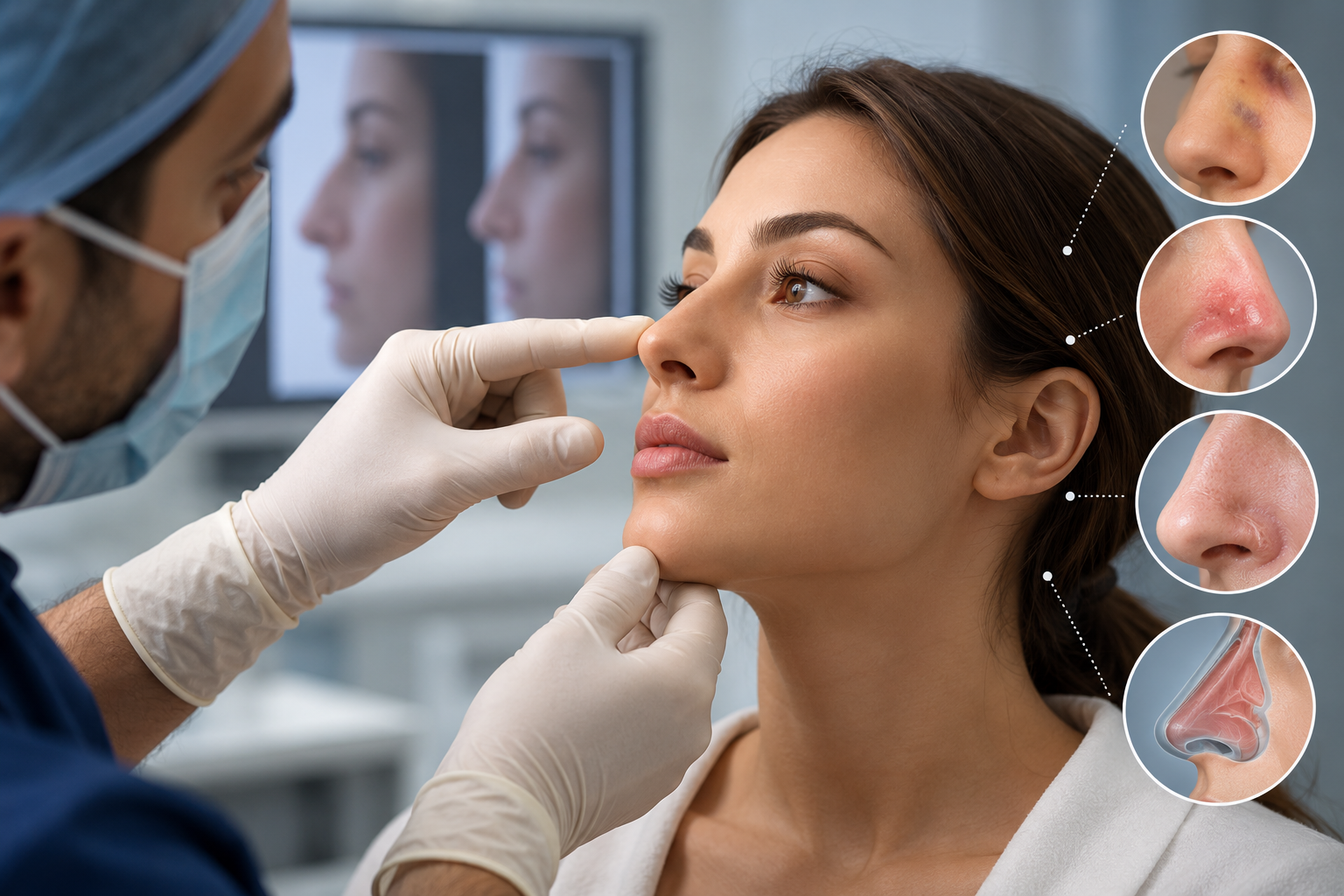
You can feel comfortable with your nose in the mirror, then see a phone photograph that makes it look wider, longer or less balanced. It is reasonable to wonder which view to trust. A photograph records a face from 1 position, at 1 moment, through a particular camera. It is not a measurement of how everyone sees you.
A close camera can exaggerate the nose relative to features farther from it. Distance, head position, lighting and image processing all matter. Before interpreting a photograph as a reason for rhinoplasty—or as evidence that a surgical result has changed—check how the image was made.
This guide explains what a photo can tell you, what it cannot establish, and how to bring a clearer question to a consultation. The 2 supplied photographs are everyday portraits, not a controlled experiment or a documented before-and-after pair. Their capture settings and clinical history are unknown.
Why can a close selfie make the nose look bigger?
The nose projects forward from the face. At a short camera distance, that difference in depth becomes a larger part of the distance between the camera and the cheeks or ears. Features nearer the camera therefore occupy more of the image relative to features farther away. This is a change in perspective, not a change in the nose itself.
A 2018 research letter in JAMA Facial Plastic Surgery used a mathematical model to examine this effect. A separate UT Southwestern study reported in 2022 compared smartphone selfies with clinical photographs and also found differences in facial proportions. Neither study provides a personal correction percentage for every phone, face or photograph.
A useful question is therefore “How close was the camera?” rather than “How many millimetres should my nose be reduced?” A single close photograph cannot answer the second question.
Is the wide-angle lens the whole explanation?
No. Focal length affects angle of view and framing. A wide view often makes it convenient to hold the phone close, and that short distance changes perspective. Moving the camera and changing the lens are related choices, but they are not the same thing.
Zooming or cropping an existing photograph does not undo the perspective from its original camera position. If you take a photograph from farther away and then crop it, you are starting with a different perspective. That distinction is more useful than assuming a particular zoom button always produces a “true” nose.
Phone models may switch between lenses or use digital processing when you change zoom. Do not treat a label such as 2×, portrait mode or rear camera as a guarantee of clinical accuracy. There is no need to buy equipment to decide whether to discuss a concern with a clinician.
How do angle and light change what stands out?
A small turn of the head changes how much of each side of the nose is visible. Raising or lowering the camera changes the view of the nostrils and tip. A 3-quarter portrait and a side profile answer different visual questions; placing them together does not make them a matched comparison.
Lighting affects the shadows and highlights that describe a contour. A directional light may emphasise an edge that softer light makes less obvious. Exposure, makeup and reflections can also affect what attracts attention. A visible difference between 2 photographs does not tell you which of these factors caused it.
Keep observations separate from explanations. “The bridge looks more prominent in this image” is an observation. “My bridge has changed shape” is a conclusion that needs more information.
Is a mirror more accurate than a photograph?
A mirror and a photograph offer different views. A mirror reflection is reversed relative to a conventional non-mirrored photograph, and you can move while looking at it. A saved selfie may or may not match the mirrored preview, depending on the app and settings.
In everyday conversation, people see a moving face from changing positions rather than a frozen, tightly cropped nose. Neither a favourite mirror view nor an unflattering phone frame is the single definitive version of your appearance. Flipping a photograph can change how familiar it feels without changing the anatomy it recorded.
For a decision about surgery, the useful reference is a clinical assessment supported by consistent photographs, your history and your goals—not a contest between the mirror and the phone.
How can I make photographs easier to compare?
If a clinic has requested photographs, follow its instructions first. For your own discussion notes, aim for consistency rather than a flattering pose. This is an editorial checklist, not a substitute for clinical photography.
1. Keep the setup consistent
Use the same device, camera and settings, a similar distance and camera height, and similar lighting. Avoid holding the camera extremely close. A stable support or another person taking the picture can help you keep the setup repeatable. Do not move closer simply to make the nose fill the frame.
2. Compare the same view
Keep your head level and expression relaxed. Compare front with front and profile with the same side profile. Leave enough of the face visible to provide context. A tight crop can hide the very facial relationships you want to discuss.
3. Keep the original file
Avoid beauty filters, reshaping tools and automatic face retouching when preparing images for a consultation. Keep an unedited original rather than only a screenshot. Record the date and any relevant recovery stage supplied by your treating team. If settings or edits are unknown, say so.
4. Write 1 clear question
Choose a small, representative set instead of taking repeated photographs until you find a reassuring angle. Add a short note: “This view concerns me because…” That gives the clinician a specific question without asking a photograph to diagnose the problem.

What should I look for in before-and-after photographs?
First ask whether the views are comparable: camera position, head angle, expression, light and framing. Then check whether the procedure and the time since surgery are stated. If either is missing, the image has limited value for understanding recovery or planning your own care.
A photograph alone cannot verify breathing function, identify every procedure performed, establish a surgeon’s involvement or predict your outcome. A more balanced-looking image is not proof of a safer operation. Our guide to rhinoplasty risks explains why appearance is only part of the decision.
The portraits in this article are supplied illustrations of everyday photography. They are not labelled as patients, treatment results or a demonstration of a known camera distance. No clinical comparison should be drawn between them.
What if my nose looks different after rhinoplasty?
Photographic differences and healing can exist at the same time. Swelling may affect appearance during recovery, so changing lighting or moving the phone cannot settle a clinical concern. Use the review schedule and photograph instructions from your own surgical team.
Describe a new concern in words as well as images: when it began, whether it is worsening, and whether you have pain, discharge or a breathing change. Do not dismiss a new symptom as camera distortion. Contact the treating team for concerning changes; severe breathing difficulty or heavy uncontrolled bleeding needs emergency care.
Our recovery guide provides the broader context. This article does not decide whether a postoperative contour is normal or whether revision surgery is needed.
What should I bring to a rhinoplasty consultation?
Bring your questions and a few unfiltered images that help explain them. Tell the clinician which concern you notice in everyday life and which appears mainly in photographs. Include breathing symptoms, previous procedures and relevant health information rather than presenting appearance as the only issue.
The American Society of Plastic Surgeons describes examination, facial measurements, photographs and discussion of goals and risks as parts of a consultation. Ask what can realistically change, what may remain, and how proposed changes relate to the whole face. A reference image or digital simulation is a discussion aid, not a promised result.
You can use our primary rhinoplasty guide to prepare for that conversation. Choosing not to have surgery, or taking more time, remains a valid option.
When is it better to pause repeated photo checking?
Disliking a photograph does not by itself indicate a mental health condition. However, if checking, comparing or hiding your appearance is taking substantial time or affecting daily life, speak with a GP or qualified mental health professional. You deserve support for that distress without needing to prove that your nose looks a particular way.
NHS guidance describes persistent appearance worries and repetitive checking as reasons to seek assessment. This article cannot diagnose body dysmorphic disorder, and a camera explanation alone is not treatment. A cosmetic decision can wait while you get appropriate support.
What is the most useful next step?
Choose a consistent, unfiltered set of photographs and a specific question. Keep the full face in the discussion. If the concern is clinical, let an examination guide it; if the concern is the photograph, start by checking the camera conditions. A thoughtful decision should still make sense when the phone is put away.
Sources and scope
Sources checked: 2 November 2026. Background: JAMA Facial Plastic Surgery; UT Southwestern Medical Center; Nikon; American Society of Plastic Surgeons; NHS; Principles of Photography and Videography, HSS Journal. General education from Rhinoplasty Team Turkey; not an individual diagnosis or a postoperative protocol. The photographs’ capture conditions and treatment histories have not been verified.
Questions about selfies and nose shape
Will 2× zoom fix selfie distortion?
Not automatically. Camera distance determines perspective; a zoom label does not guarantee consistent conditions. Cropping a photograph already taken cannot undo its original perspective.
Can a photograph show whether I need rhinoplasty?
A photograph can help explain a concern, but it cannot replace an examination, breathing assessment or discussion of your goals and health history.
Should I use a filtered photograph as my goal?
Bring unedited images and describe the feature that concerns you. A filtered image or simulation is not a reliable promise of what surgery can achieve.
Are the 2 photographs here a before-and-after pair?
No. They are supplied everyday portraits with unknown capture conditions and treatment histories. They should not be compared as evidence of a clinical change.
Rhinoplasty Team Turkey
Continue your research
Rhinoplasty Team Turkey